
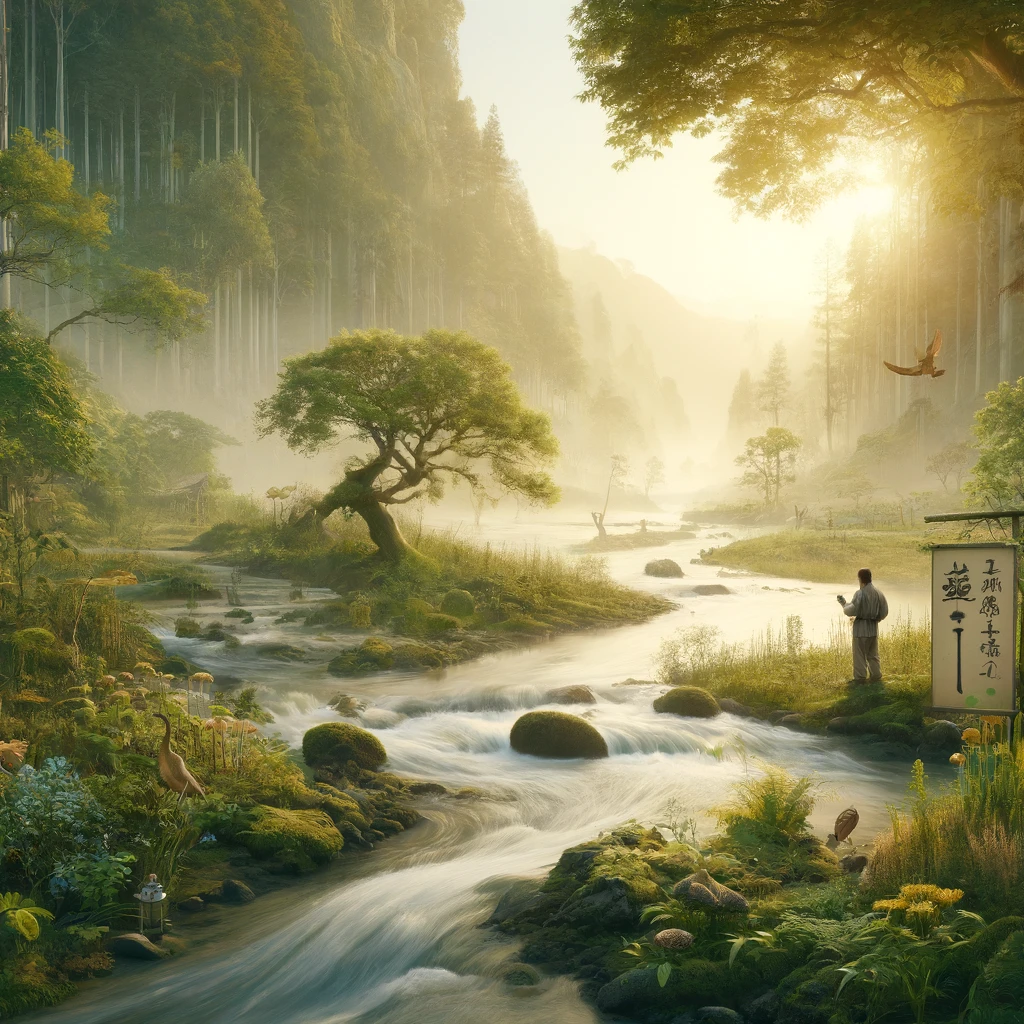
The Photographer, the Old Man, and the Illusion of Control – Wu Wei, Permaculture, and the Limits of Left-Brain Thinking
Introduction: The Moment I Let Go
I used to believe that great photography was about control. If I planned every detail—lighting, composition, subject—surely I’d create perfect images. But more often than not, the best shots happened when I wasn’t forcing anything. The perfect golden-hour glow appeared just as I was about to pack up. The most striking composition emerged not from my careful framing, but from an unexpected angle I hadn’t planned.
I realized that the more I tried to impose my vision, the more I missed the magic of what was already there.
This tension between control and flow isn’t just a photography lesson—it’s a life lesson. And perhaps no story explains this better than the ancient Chinese parable of the old man who lost his horse.
The Old Man Who Lost His Horse (Long Version)
Once upon a time, in the northern frontier of ancient China, there lived an old man known as Sai Weng (塞翁). He was known for his wisdom and calm demeanor. Sai Weng owned a beautiful horse, which was his pride and joy.
One day, his horse ran away across the border into the lands of a neighboring tribe. Upon hearing this, his neighbors came to console him.
“What a terrible misfortune! Such a fine horse, and now it is gone!” they lamented.
But Sai Weng only smiled and said,
“Who knows if this is a good thing or a bad thing? We can only wait and see.”
Days later, the horse returned home, bringing with it several strong and majestic wild horses. Sai Weng’s wealth had now increased, as he now had more horses than before.
His neighbors came to celebrate, saying,
“You were right! What a stroke of great fortune! You must be so happy!”
Again, Sai Weng responded with his calm smile,
“Who knows if this is truly good or bad? We shall see.”
Not long after, Sai Weng’s only son, a strong and capable young man, decided to tame one of the wild horses. But the horse was fierce and untrained, and as the young man rode it, he was violently thrown off. He fell to the ground, breaking his leg badly.
His neighbors came once more, shaking their heads in sorrow.
“Such bad luck! Your only son is now crippled. Who will take care of you in your old age?”
Sai Weng still did not seem distressed. He simply said,
“Good luck, bad luck—who can truly say? Let’s wait and see.”
Months later, a war broke out, and all the young men in the village were conscripted into the army. Many perished in battle, never to return home.
But Sai Weng’s son, because of his injured leg, was deemed unfit for combat and was spared.
The neighbors, astonished by this twist of fate, came once again and exclaimed,
“What incredible fortune! Because of his injury, your son was saved from certain death!”
Sai Weng once more said with a knowing smile,
“Who knows if this is good or bad? The future is uncertain.”
And so, life continued, ever changing, with misfortunes leading to blessings and blessings turning into misfortunes. Sai Weng understood that fortune and disaster are two sides of the same coin, and that one should not be too quick to judge events as entirely good or bad.
Wu Wei, the Left-Brain Problem, and the Western Obsession with Control
This parable, rooted in Daoist philosophy, challenges the Western mindset of rigid control, logic, and categorization.
The West has, for centuries, prioritized left-brain thinking—analytical, linear, reductionist thought that seeks to break the world into pieces to study, measure, and control it.
We see this in:
- The scientific method, which isolates variables to understand phenomena.
- The industrial revolution, which mechanized nature to extract maximum productivity.
- Modern capitalism, which reduces land, animals, and even people into economic units.
But as neuroscientist Iain McGilchrist argues in The Master and His Emissary, excessive left-brain dominance disconnects us from holistic, right-brain ways of knowing—intuition, connection, and the ability to see things as an interconnected whole.
The Daoist perspective is inherently right-brained.
It does not seek to control, predict, or manipulate nature. Instead, it embraces uncertainty, emergence, and organic flow—just like Sai Weng, who does not react with attachment or resistance to the events in his life.
Permaculture: Observing and Flowing with Nature
Nowhere is the contrast between control and flow more evident than in agriculture.
Western industrial farming is an exercise in domination:
- Monocultures replace natural biodiversity.
- Pesticides kill all “undesirable” species.
- Genetic modification engineers life itself to fit our desires.
But nature does not work in straight lines or rigid categories. In contrast, permaculture—a holistic, regenerative design philosophy—embraces nature as it is.
Permaculture follows Wu Wei (无为):
- It observes before it acts.
- It works with rather than against natural patterns.
- It lets go of rigid expectations, allowing nature to self-organize.
A permaculture farmer does not force crops into neat rows but instead creates conditions for diversity and resilience to emerge naturally.
This mirrors Wu Wei in action—instead of controlling, we cooperate with the natural flow of life.
How This Mirrors My Journey in Photography
I’ve always found this story fascinating because it mirrors my own journey in photography.
I used to believe that photography was about control—getting the perfect exposure, the perfect composition, the perfect moment. But like industrial farming, this approach is rigid, limiting, and disconnected from the organic beauty of the world.
Some of my best photos have come when I was not trying to control the scene, but simply being present, observing.
Once, my camera malfunctioned—and I was forced to use my phone instead. I was frustrated at first. But in working with this limitation, I began to see light and composition in a completely new way.
What seemed like a setback was actually a gift.
This was Wu Wei in action—not forcing, not grasping, simply adapting to what is given.
Breaking Free from the Illusion of Control
We have been conditioned to believe that:
- Success = Control
- Failure = Lack of Control
But what if control itself is the illusion?
The West treats life like a machine—a series of inputs and outputs. But life is not a machine; it is a living, breathing ecosystem.
And like an ecosystem, life flows best when it is allowed to be as it is.
Photography, Permaculture, and the Daoist Way
Both photography and permaculture teach us to let go of fixed expectations:
- Instead of chasing a perfect shot, we open ourselves to whatever moment presents itself.
- Instead of imposing rigid systems on nature, we create conditions for harmony to emerge.
This is Wu Wei.
It is not passive, but deeply engaged—a way of being that is both fully present and completely unattached.
And so, whether I am behind the lens or working with the land, I now let go, trust, and flow with what is given.
Because in the end…
Who knows if something is good or bad?
All I need to do is stay present, adjust my focus, and keep capturing the world—one frame at a time.
Real-World Applications of Wu Wei
How to Apply Wu Wei in Daily Life
- In Work & Business – Avoid rigid planning and embrace adaptability. Many successful entrepreneurs thrive by pivoting when unexpected opportunities arise instead of sticking to an inflexible plan.
- In Creativity (Photography, Art, Music, Writing) – Inspiration cannot be forced. Instead of obsessing over perfection, immerse yourself in the process and allow creativity to flow naturally.
- In Decision-Making – Rather than overanalyzing, take a step back and let solutions present themselves. Often, the best decisions emerge when we stop trying to control every variable.
- In Relationships – People, like nature, thrive best when not constrained. Wu Wei encourages us to let relationships evolve organically rather than trying to force connections or outcomes.
- In Gardening & Nature – Observe before acting. Let ecosystems self-regulate rather than imposing artificial control. Learn from how natural landscapes sustain themselves without interference.
Final Thoughts
Photography, permaculture, and life itself are all about deep listening.
The Western world may still be obsessed with left-brain domination, but nature, creativity, and wisdom belong to those who can listen to the whole.
If we wish to truly see, we must first surrender to the flow.
Because life is not something to be controlled—it is something to be experienced.
And perhaps, that is the real art of living.
FAQs: Wu Wei, Permaculture, and Control vs. Flow
What is Wu Wei (无为) and why is it important?
Wu Wei translates to “effortless action” or “going with the natural flow of life”. It teaches that trying to dominate or resist nature leads to unnecessary struggle. Instead, aligning with the rhythms of life allows for greater ease, adaptability, and success.
How does Wu Wei relate to Permaculture?
Permaculture follows the same principles as Wu Wei:
- Work with natural cycles instead of forcing outcomes.
- Observe and adapt instead of imposing rigid systems.
- Allow ecosystems to self-organize rather than over-engineering them.
How does Wu Wei apply to Photography and Creativity?
- The best photos often happen when a photographer responds to the moment rather than rigidly controlling every aspect.
- Creativity flows best when we let go of perfectionism and trust the process.
- Wu Wei reminds us that some of the most striking moments are unplanned.
Is Wu Wei just passivity?
No! Wu Wei does not mean doing nothing. It means acting in harmony with circumstances rather than forcing control. It’s about moving with natural energy rather than against it.
What is the connection between Wu Wei and Flow State?
Flow state, often discussed in modern psychology, is similar to Wu Wei—it describes a mental state where actions feel effortless and immersive. The key difference is that Wu Wei is not just about personal performance but about attuning to the larger natural world.
How does Wu Wei apply to daily life?
Wu Wei applies to daily life, work, creativity, relationships, and even personal growth. Examples include:
- In Work: Instead of over-planning and micromanaging, trust the process and adapt as new opportunities arise.
- In Creativity (Photography, Writing, Art): Instead of forcing inspiration, allow it to emerge naturally through deep observation and immersion.
- In Decision-Making: Let go of rigid expectations. Many times, forcing an outcome creates resistance, while allowing space for organic growth leads to better results.
- In Relationships: Trying to control people or situations often leads to stress. Wu Wei suggests fostering mutual flow rather than dominance.
What is the connection between Wu Wei and Permaculture?
Both Wu Wei and permaculture emphasize working with natural patterns instead of against them.
- Conventional agriculture imposes control on nature through monocultures, pesticides, and artificial inputs.
- Permaculture follows nature’s flow by observing ecosystems, building biodiversity, and allowing plants to self-regulate.
Just as Wu Wei advises that forcing things creates resistance and inefficiency, permaculture teaches that unnatural interference weakens ecosystems.
How does Wu Wei relate to photography and creativity?
Wu Wei is deeply connected to creative flow. Some of the greatest works of art, music, and photography come not from forced effort but from effortless immersion.
In photography:
- Over-planning can make a shot feel staged and artificial.
- Being present and observant allows for capturing authentic, spontaneous moments.
- Instead of chasing an image, let the scene unfold and work with what is given.
Many artists describe being in a flow state, where they lose sense of time and effort, simply creating without overthinking—this is the essence of Wu Wei in creativity.
How does the Western mindset of control differ from the Daoist perspective?
Western thought has historically been shaped by a mechanistic worldview, where the universe is seen as a system of separate, controllable parts. This has led to:
- Reductionism (breaking things into smaller components rather than seeing the whole).
- Industrial agriculture (imposing rigid systems onto nature rather than working with it).
- Hyper-rationalism (rejecting intuition, spontaneity, and holistic understanding).
Daoism, on the other hand, sees reality as interconnected and ever-changing. It does not believe that everything can be controlled, predicted, or engineered. Instead, it encourages openness to the unknown, adaptation over dominance, and trusting the flow of life.
What are some examples of Wu Wei in history?
- Laozi (老子): The author of the Dao De Jing (道德经), Laozi emphasized that the best rulers lead without force, allowing their people to govern themselves naturally.
- Zhuangzi (庄子): The Daoist philosopher Zhuangzi wrote extensively on living effortlessly, using parables about fish swimming in harmony and artisans who master their craft through deep attunement, not excessive effort.
- Miyamoto Musashi: The legendary Japanese samurai wrote about “no mind” (Mushin 無心)—a concept similar to Wu Wei, where the warrior fights best when he is not overthinking, but moving instinctively.
What is the connection between Wu Wei and Flow State?
Wu Wei and flow state (as described by psychologist Mihaly Csikszentmihalyi) are strikingly similar.
- Wu Wei: A Daoist principle of effortless action, trusting life’s natural flow.
- Flow State: A psychological state where a person is fully immersed in an activity, losing self-consciousness and experiencing deep enjoyment.
Both suggest that optimal performance happens not through force or struggle, but through deep attunement and presence.
What is the meaning of “Who knows if something is good or bad?”
This phrase is the central lesson from the Sai Weng (塞翁失马) parable. It reminds us that life’s events cannot always be judged immediately.
- Something that seems bad now (a missed opportunity, a failure) may lead to unexpected benefits later.
- Something that seems good now (a major success, wealth, power) may bring unforeseen problems.
It teaches detachment from rigid judgment and encourages a mindset of open curiosity toward life’s unfolding events.
Is Wu Wei the same as doing nothing?
No! Wu Wei is not passivity or inaction. It means acting in harmony rather than through force.
A skilled musician does not play music by stiffly controlling every note—they allow the melody to flow naturally through their hands.
A great leader does not govern by micromanaging—they create an environment where things self-organize effectively.
Similarly, Wu Wei is about action that arises naturally, rather than action forced by ego or fear.
How can I practice Wu Wei in my own life?
- Observe before acting: Whether in work, relationships, or creative pursuits, pause and see what is already unfolding before jumping in.
- Let go of rigid expectations: Be open to outcomes rather than clinging to a specific plan.
- Move with nature’s rhythms: Whether it’s the seasons, market trends, or personal energy cycles, work with what is present instead of resisting.
- Trust the process: Whether learning a new skill, healing from a setback, or building something long-term, trust that progress happens in its own way.
Final Thoughts: Embracing Wu Wei in a World Obsessed with Control
Wu Wei is a radical antidote to the modern world’s addiction to busyness, struggle, and control.
- It reminds us that effort is not the same as effectiveness.
- It shows that things unfold best when we stop clenching so tightly.
- It reveals that true mastery—whether in life, art, or leadership—is about moving with, not against, the natural way of things.
Whether in photography, permaculture, personal growth, or daily living, the lesson remains the same:
Let go, trust, and flow.
Because in the end…
Who knows if something is good or bad?


